
EPA 608 Study Guide: Section-by-Section Prep for Core, Type I, II, and III
Complete study guides for all four EPA 608 exam sections — Core, Type I, Type II, and Type III — with verified regulatory facts and embedded practice questions.
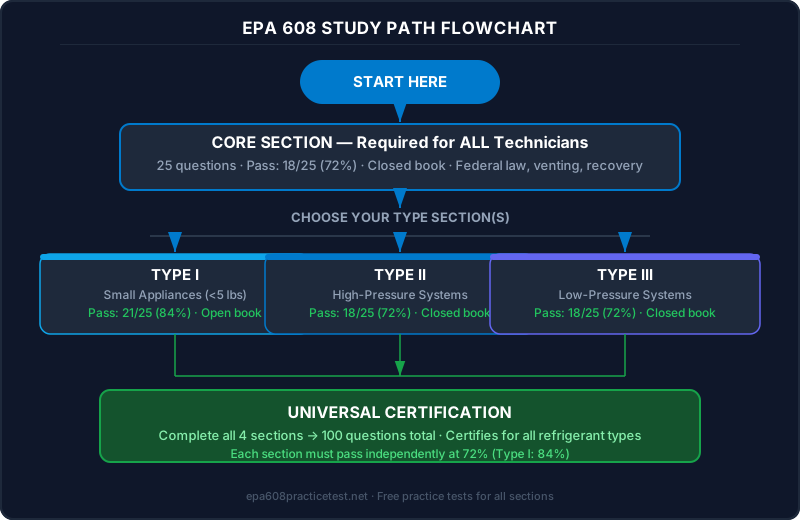
EPA 608 certification requires passing the Core section plus at least one type-specific section. The Core section — mandatory for all technicians — tests federal law. The type-specific sections (Type I, II, III) test equipment-specific recovery procedures, refrigerant properties, and service standards. Each section has 25 questions; passing requires 18 correct (72%). Before diving into study materials, take the EPA 608 mini-quiz to identify which sections need the most attention. This hub links to the complete study guide for each section. For additional practice with answer explanations, try our EPA 608 practice test with answers. Not sure where to start? Read our guide on how to study for EPA 608 for a section-by-section study plan and time estimates.
Core Section
Clean Air Act, venting prohibition, civil penalties, recovery/recycling/reclamation
Type I
Small appliances, 5-lb rule, 80%/90% recovery thresholds, process stubs
Type II
High-pressure systems, 3-tier leak rates, vacuum requirements, A2L transition
Type III
Low-pressure chillers, 25 mm Hg recovery, purge units, freezing risk
How to Use These EPA 608 Study Guides
Each study guide on this site corresponds to one section of the EPA 608 exam. The guides are written from verified regulatory sources — not from other study guides — and include the specific facts that certifying organizations use to write exam questions. If you need help planning when to cover each section, use our EPA 608 study schedule to map out a day-by-day plan based on your experience level.
Recommended study sequence:
- Core first. The Core section establishes the legal framework that all type-specific content builds on. Technicians who skip Core and jump to Type II first consistently struggle with regulation-based questions in the type-specific sections because the underlying law is unfamiliar.
- Type II second (for most technicians). Type II covers the broadest range of real-world equipment — residential split systems, commercial refrigeration, rooftop units. Most technicians who are already in the field encounter Type II equipment first.
- Type I third. Type I is generally considered the least difficult section. The 5-pound rule and the 80%/90% threshold system are the primary test content. Type I study is faster than Core or Type II.
- Type III last (if pursuing Universal). Type III covers the most counter-intuitive physics — vacuum operation and low-pressure systems are unfamiliar to most technicians. Allocate extra study time for Type III before the Universal exam.
Study Pace by Experience Level
Most technicians with field experience need 4–8 hours of focused study per section. Technicians entering from outside the HVAC field (career changers, apprentices in first year) should plan for 8–16 hours per section.
EPA 608 Core Section: What to Study First
The EPA 608 Core study guide covers Clean Air Act Section 608 law, venting prohibitions, civil penalties, refrigerant classification, and the recovery-recycling-reclamation distinction.
Most tested Core facts:
- Venting prohibition dates: July 1, 1992 (CFCs and HCFCs); November 15, 1995 (HFCs). Both dates are tested — know which date applies to which refrigerant class.
- Civil penalty: More than $44,539 per day per knowing violation.
- De minimis exemption: 0.1 ounce or less of refrigerant — the only quantity-based exception to the recovery obligation.
- Recovery vs recycling vs reclamation: Recovery = removed and stored. Recycling = cleaned on-site (not ARI-700). Reclamation = reprocessed to ARI-700 at certified facility; required before resale.
- Citizen suit provision: Any person may report Section 608 violations — not just inspectors or government employees.
True or False Test
You can earn Type II certification without passing the Core section.
False — the Core section is mandatory for all certification types. No type-specific certificate is issued without a passing Core score.
EPA 608 Type I, II, and III: Equipment-Specific Study Guides
EPA 608 Type I study guide — Small appliances, 5-pound rule, 80%/90% recovery thresholds, system-dependent vs self-contained recovery, process stubs. Focus facts: the 5-pound rule applies to manufactured charge (not current charge); system-dependent (passive) recovery: 80% when compressor is operating, 90% when non-operating; self-contained (active): 90% always; disposable cylinder prohibition.
EPA 608 Type II study guide — High-pressure systems, three-tier leak rate system, recovery vacuum requirements, R-22 phase-out, A2L transition. Focus facts: 10%/20%/30% leak thresholds by equipment category; 10 inches Hg vacuum for systems under 200 lbs, 15 inches Hg for 200 lbs+; R-22 phase-outs (new equipment 2010, all production 2020); R-454B and R-32 replacing R-410A.
EPA 608 Type III study guide — Low-pressure centrifugal chillers, vacuum operation physics, 25 mm Hg absolute recovery, purge units, the freezing risk. Focus facts: low-pressure systems operate below atmospheric pressure; air enters through leaks (not refrigerant escaping); purge unit draws from condenser top; 25 mm Hg absolute for post-1993 equipment; liquid refrigerant charging can freeze chiller tubes.
EPA 608 Night-Before Study Strategy: What to Review Last
The night before your EPA 608 exam, review high-frequency memorization content — the facts most likely to appear as distractors. Spending 30–45 minutes on these specific items before sleep is more effective than re-reading complete study guides. To understand how our practice tests compare to the real EPA 608 exam, see the detailed breakdown of question format, difficulty, and scoring differences.
| Category | Key Facts to Memorize |
|---|---|
| The three dates | July 1, 1992 (CFC/HCFC ban); November 15, 1993 (recovery equipment cutoff); November 15, 1995 (HFC ban) |
| Type I recovery | System-dependent (passive): 80% working, 90% non-working Self-contained (active): 90% |
| Type II recovery | Under 200 lbs: 10 inches Hg vacuum 200 lbs or more: 15 inches Hg vacuum |
| Type III recovery | Post-1993: 25 mm Hg absolute |
| Key numbers | De minimis: 0.1 oz Civil penalty: >$44,539/day Passing: 18 of 25 per section Type I open-book: 84% |
| Leak rates | Comfort cooling: 10% Commercial refrigeration: 20% Industrial process (IPR): 30% |
Terminology Traps
Recycling ≠ Reclamation (only reclamation meets ARI-700). System-dependent ≠ Self-contained (system-dependent uses appliance compressor). Venting ≠ Purging (purging removes non-condensables from chillers, not illegal release of refrigerant).
EPA 608 Study Guide FAQ
Have questions about certification requirements, exam logistics, or retake policies? See our EPA 608 FAQ for answers to the most common questions. Or start with the free EPA 608 practice test directly — no signup, instant results for each section.
EPA 608 Practice Questions
A) True B) False
The Core section is mandatory for all EPA 608 certification types (Type I, Type II, Type III, and Universal). No type-specific certificate is issued without a passing Core score.
A) Type I → Type II → Type III → Core B) Core → Type II → Type I → Type III C) Any order — sections are independent D) Type III first because it is the most difficult
The recommended sequence is Core first (establishes legal framework), then Type II (most common real-world application), then Type I (simpler content), then Type III (most counter-intuitive physics). This sequence builds comprehension progressively.
A) 0.1 ounce of refrigerant B) 1 ounce of refrigerant C) 1 pound of refrigerant D) 5 pounds of refrigerant
The de minimis exemption provides that recovery is not required for refrigerant releases of 0.1 ounce or less. Any release above this amount requires recovery equipment regardless of refrigerant type.
A) 70% B) 75% C) 80% D) 84%
The Type I section is available as an open-book mail-in exam through some providers, but the passing threshold increases to 84% — compared to 72% for the proctored version. This option reduces proctoring requirements for technicians seeking only Type I certification.
A) Type I — small appliances B) Type II — high-pressure systems C) Type III — low-pressure systems D) Core — all systems
Type III (low-pressure centrifugal chillers) requires recovery to 25 mm Hg absolute pressure for equipment manufactured after November 15, 1993. This is the deepest vacuum requirement of any EPA 608 certification type.
A) Refrigerant escapes to the outside atmosphere B) The system pressure rises above atmospheric C) Air and moisture enter through the leak D) The compressor shuts down automatically
Low-pressure chillers operate below atmospheric pressure. When a leak occurs, outside air (at higher pressure) enters the system rather than refrigerant escaping — the opposite of high-pressure system behavior. This is why purge units are needed.
A) HFOs B) HFCs C) HCFCs D) CFCs
CFCs (chlorofluorocarbons) such as R-11 (ODP 1.0) and R-12 have the highest ozone depletion potential. HCFCs have lower ODP than CFCs, HFCs have zero ODP, and HFOs have near-zero ODP.
A) Removing refrigerant from a system and storing it in an external container without necessarily testing or processing it B) Cleaning refrigerant using oil separation and filter-driers C) Reprocessing refrigerant to ARI-700 purity at a certified facility D) Adding refrigerant to bring a system to proper charge
Recovery is the process of removing refrigerant from a system and storing it in an approved recovery cylinder — without processing or testing. The recovered refrigerant may then be recycled (cleaned) or reclaimed (reprocessed to ARI-700) in a separate step.
Official Regulatory Sources
Information on this page is based on EPA Section 608 regulations and 40 CFR Part 82 — the federal rules governing refrigerant management, recovery requirements, and technician certification under the Clean Air Act.
Start with the Core Section
Clean Air Act law, venting dates, civil penalties, and the recovery-recycling-reclamation distinction.
Then move to the 608 Type II study guide for high-pressure systems — the most widely-used certification for commercial and residential HVAC.