
What's newNew: 2026 Section 608 test bank, with A2L questions
Free EPA 608 Practice Test
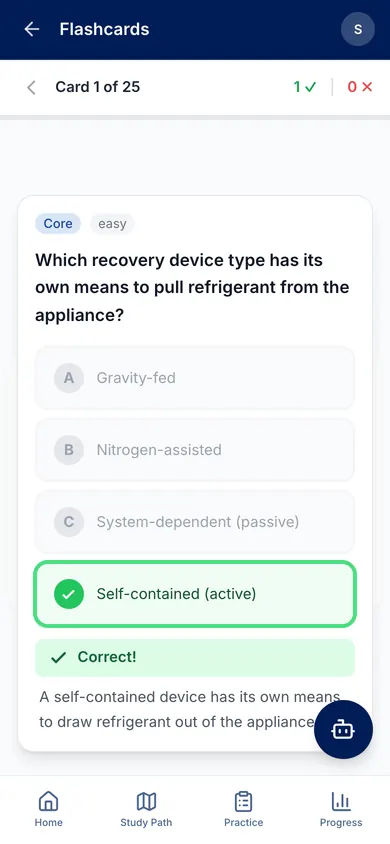
Practice for the EPA Section 608 technician exam in the same format: 25 multiple-choice questions per section, 18 of 25 to pass each one. Try today's question below with no signup and see the explanation right away.
No signup · 25 questions · an explanation on every answer
EPA 608 question of the day
One question · see why right away
-
Which part of a CFC or HCFC molecule causes ozone depletion in the stratosphere?
Correct answer: C. Chlorine
The chlorine in CFC and HCFC molecules is what destroys stratospheric ozone.
-
Without reclaiming, where can recovered refrigerant be used?
Correct answer: B. Only in the same appliance or another appliance owned by the same person
Recovered refrigerant may go back into the same appliance, or another appliance owned by the same person, without reclaiming; selling it to anyone else requires reclaiming it first.
-
What makes a small refrigerant release during service a de minimis release?
Correct answer: D. It occurs during a good-faith recovery attempt
A release is de minimis only when it happens during a good-faith attempt to recover or recycle refrigerant with the required practices followed; there is no pound or percent limit.
-
Why is a large refrigerant leak in a basement or other low, enclosed space dangerous?
Correct answer: B. Refrigerant vapor is heavier than air and can displace oxygen
Most refrigerant vapor is heavier than air, so a large leak in a low, enclosed space can push out oxygen and cause suffocation.
-
A buyer has no Section 608 or Section 609 certification, employs no certified technician, and wants refrigerant for their own use. Which sale is allowed?
Correct answer: C. A 2 lb can of R-134a for car AC with a unique fitting and self-sealing valve
Regulated refrigerant may be sold only to certified technicians or their employers. The exception is car-AC cans of 2 lb or less with a unique fitting and a self-sealing valve.
-
Which list orders these refrigerants from highest to lowest ozone depletion potential?
Correct answer: A. CFC-12, HCFC-22, HFC-134a
CFC-12 has an ODP of 1.0, HCFC-22 has 0.055, and HFC-134a has 0 because it contains no chlorine.
-
Which of the following is a common cause of refrigerant leaks?
Correct answer: D. Vibration and wear on aging equipment that cracks joints or rubs through tubing
Most leaks come from vibration and wear that crack joints or rub through tubing on aging equipment.
-
After the vacuum pump is isolated, the micron reading rises and then levels off below atmospheric pressure. What does this usually mean?
Correct answer: A. Moisture is still boiling out of the system
If the reading rises and then levels off, moisture is still boiling off; if it keeps rising toward atmospheric pressure, there is a leak.
-
A recovery cylinder has a water capacity of 50 lb and a tare weight of 30 lb. The refrigerant's specific gravity is 1.10. Using the 80% safe-fill limit, what is the most the filled cylinder should weigh?
Correct answer: C. 74 lb
Max gross weight = water capacity × specific gravity × 0.80 + tare: 50 × 1.10 × 0.80 = 44 lb of refrigerant, plus 30 lb tare = 74 lb.
-
Where does the common 500-micron vacuum target come from?
Correct answer: B. Industry practice for dehydrating a system before charging
500 microns is an industry dehydration target. EPA's required recovery levels are in inches Hg (Table 1); even the deepest, 25 mm Hg absolute for low-pressure appliances, is 25,000 microns.
Core is required for every certification, whatever type you take.
Take the full Core test (25 questions)Pick an EPA 608 practice test by section
Every technician needs Core plus the type that matches the equipment you work on. Universal certification means all four sections.
-
Start here · required for every type
Core practice test
Venting rules, recovery, recycling and reclamation, refrigerant classes and safety.
-
Type 1 practice test
Type 1 (Type I) covers small appliances: hermetically sealed at the factory with 5 lb or less of refrigerant, like household refrigerators and window units.
-
Type 2 practice test
Type 2 (Type II) covers medium-, high- and very high-pressure appliances: split-system air conditioning and heat pumps on R-410A or R-22, commercial refrigeration.
-
Type 3 practice test
Type 3 (Type III) covers low-pressure appliances below 45 psia, mostly centrifugal chillers on R-123.
-
Universal practice test
All four sections, 100 questions, each section scored on its own.
Every question checked against
- EPASection 608 test topics
- eCFR40 CFR Part 82, Subpart F
- Federal RegisterSNAP refrigerant rules
- DOT49 CFR cylinder rules
- AHRIStandard 700 · K · M · N
Sources only. Not affiliated with or endorsed by EPA.
Built for the 2026 Section 608 test bank
-
Updated for 2026
A2L refrigerants like R-32 and R-454B, the new A2L cylinder markings and the current leak-repair rules. Questions that appear only on the older 2018 exam are labelled.
Updated when federal rules change or learners report a problem. Last update: .
-
903 varied questions
All four sections across 28 EPA test topics, with 100+ on-the-job scenarios in multiple-choice, true/false and select-all formats.
-
Every question checked
Each question is checked against the federal rules (40 CFR Part 82, Subpart F), EPA's Section 608 test topics or the industry standard it covers. See every source
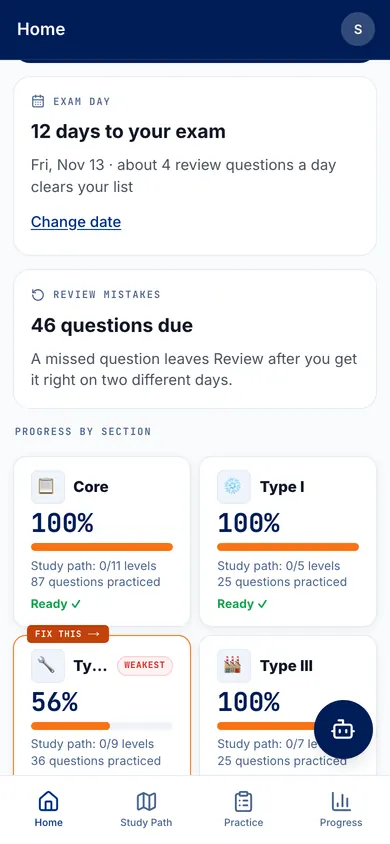
See how EPA608PracticeTest finds your weak section
Your scores, score history, weak spots and exam-day plan are saved with a free account, on any device.
-
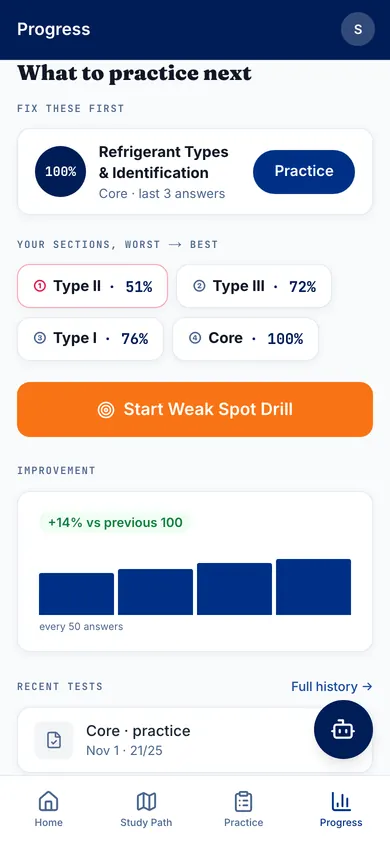
See your sections ranked from weakest to strongest, so you know what to practice next.
-
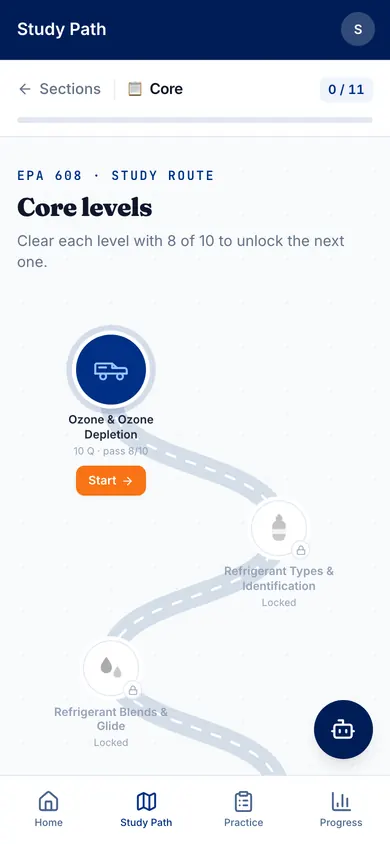
Work through the Study Path level by level. Score 8 of 10 on a level's quiz to open the next one.
-
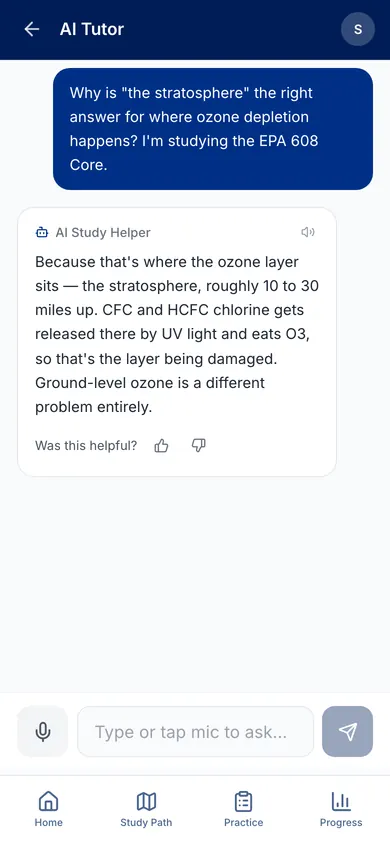
Ask why an answer is right, in plain English. Free accounts get 10 questions a month.
-
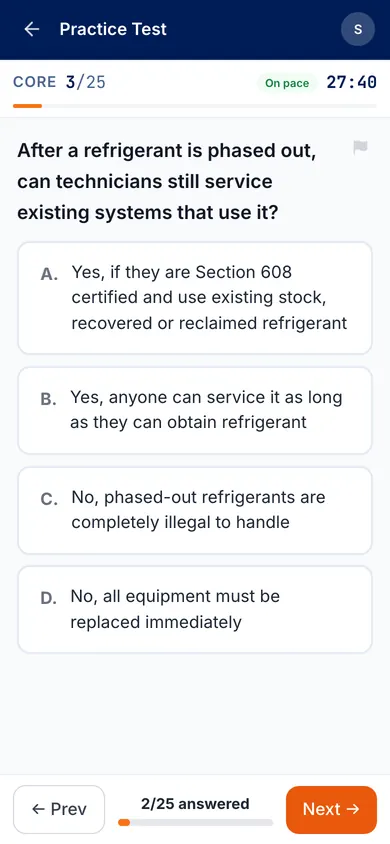
Run a section in 30 minutes, or all 100 questions in 3 hours.
-
Set your test date to get a countdown and a daily review target based on the questions you missed.
-
Review the numbers and rules you keep missing between practice sessions.
Where the EPA 608 practice questions come from
Every question is checked against the federal rule text, EPA's test topics or the industry standard it covers, and each one records the source it was checked against.
- EPA Section 608 technician certification test topics. For Core: environmental impacts, the Clean Air Act and Montreal Protocol, substitute refrigerants and oils, refrigeration, the three R's, recovery techniques, dehydration and evacuation, safety and shipping. For Type I, II and III: recovery requirements, recovery techniques, leak detection and leak repair requirements.
- 40 CFR Part 82, Subpart F (§82.150 to §82.169) and its Appendix D exam standard, checked against the eCFR text of October 28, 2026.
- EPA SNAP rules on flammable and A2L refrigerants, published in the Federal Register.
- DOT cylinder rules in 49 CFR.
- AHRI Standard 700 and AHRI Guidelines K, M and N, for refrigerant purity, recovery cylinders, service ports and cylinder colors.
- New 2026 questions written from the rule text
- Older questions re-checked line by line in October 2026, 49 retired
- Each question records the source it was checked against
Questions about AIM Act rules are labelled "Not on the 608 exam". Not affiliated with or endorsed by ESCO Institute or EPA.
EPA 608 practice test FAQ
Quick answers about cost, the questions and how scoring works.
Is this EPA 608 practice test free?
Yes. Every section test on this site runs in your browser with no signup. Create a free account to practice from the full bank of 900+ questions and keep your scores, score history and weak spots on any device.
Are these the real EPA 608 exam questions?
No. Certifying organizations keep their exam questions private. These are practice questions in the same format, written for the 2026 Section 608 test bank and checked against the federal rules.
How is the EPA 608 practice test scored?
Each section test has 25 questions and is scored on its own. You pass a section at 18 of 25, the same mark the real exam uses. The Universal test covers all four sections, 100 questions.
Find your weak section before test day.
- Works in any phone browser
- No app install
- No card to start
- Not affiliated with ESCO Institute or EPA